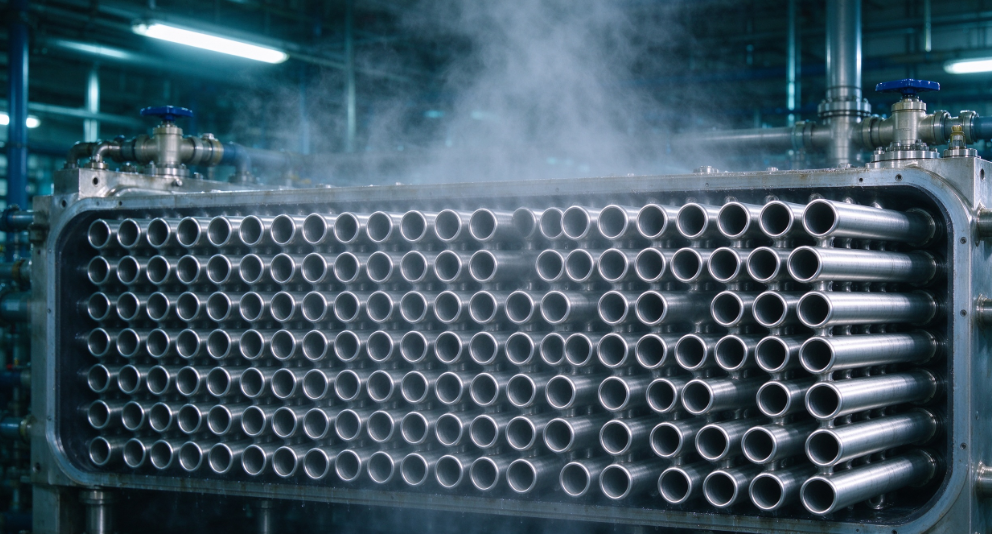
Seawater desalination heat exchangers work in an extremely harsh environment: continuous contact with high-chloride seawater, concentrated brine, temperature changes, and biofouling. Copper alloy, carbon steel and ordinary stainless steel heat exchange tubes easily suffer pitting corrosion, perforation and leakage, which leads to frequent shutdown and high maintenance costs. Titanium tubes have become the mainstream reliable choice for multi-effect distillation (MED), multi-stage flash (MSF) and other desalination heat exchanger systems.
1. Excellent Resistance to Chloride Pitting & Crevice Corrosion
The core advantage of titanium is its self-repairing passive TiO₂ oxide film. This dense protective layer is stable even in full-concentration seawater and hot concentrated brine.
Chloride ions cannot destroy titanium’s passive layer, unlike 316L stainless steel which suffers pitting quickly in warm seawater;
It resists crevice corrosion under gasket deposits, sludge and biofilm, the most common failure position of heat exchanger tubes.
This property is the primary reason desalination plants adopt titanium.
2. Good Heat Transfer Performance & Thin-Wall Design
Titanium has suitable thermal conductivity for heat exchange equipment. Manufacturers can produce thin-wall seamless titanium tubes (ASTM B338) without sacrificing corrosion safety.
Thinner walls reduce thermal resistance and improve heat transfer efficiency, helping desalination systems lower energy consumption. Compared with expensive high-grade nickel alloys, titanium achieves a better balance of heat transfer performance and cost.
3. Anti-Fouling & Anti-Biofouling Characteristics
Titanium surface is smooth and chemically inert. Marine organisms such as barnacles and algae attach less easily to titanium than copper and steel.
Even when biofilm forms, the base material will not corrode rapidly under the fouling layer. Routine chemical cleaning (acid flushing) will not damage the titanium substrate, which greatly extends the service cycle between cleanings.
4. Long Service Life & Low Lifecycle Cost
Desalination projects are long-term fixed-asset investments.
Copper-nickel tubes usually need replacement after several years of operation, while titanium heat exchanger tubes can stably serve 20+ years.
Although the initial purchase cost is higher, titanium avoids production loss caused by tube leakage, plugging and replacement, bringing obvious economic advantages for large-scale desalination stations.
5. High Toughness, Fatigue Resistance & Weldability
Heat exchangers are subject to cyclic temperature changes, flow vibration and water hammer impact.
CP titanium Grade 2 (TA2 / GR2) is the most common grade for desalination heat tubes. It has good ductility, vibration fatigue resistance and stable welding performance. Tube-to-tube sheet welding can be reliably implemented on site or in the factory.
6. Compatible with Common Desalination Process Chemicals
Desalination systems regularly add chlorine, scale inhibitors and cleaning agents.
Titanium is resistant to low-level chlorinated seawater and most common water treatment chemicals. It does not form toxic dissolved ions, which also guarantees the safety of produced fresh water.
Key Notes for Material Selection
Grade selection: Grade 2 (CP Titanium) is the standard grade for seawater desalination heat exchanger tubes;
Standard: ASTM B338 seamless and welded titanium tubes are widely specified in desalination EPC projects;
Galvanic corrosion: Isolate titanium from carbon steel components properly to prevent galvanic attack on carbon steel;
Inspection: EN 10204 3.1 / 3.2 test certificates are normally required for project acceptance.
Summary
High chloride content in seawater and concentrated brine is fatal to many metal heat exchange tubes. Benefiting from the self-healing passive oxide film, titanium tubes have outstanding pitting and crevice corrosion resistance. Combined with stable heat transfer performance, good cleanability and ultra-long service life, titanium has become the preferred material for seawater desalination heat exchangers.
If you need ASTM B338 titanium tubes for desalination heat exchangers, please contact us for technical datasheets and formal quotation.
Technical Guide5 min read·2026-10-22
Why Titanium Tubes Are Used for Heat Exchangers in Seawater Desalination
Find out why titanium tubes are the preferred material for seawater desalination heat exchangers. Learn about chloride corrosion resistance, anti-fouling performance, service life, ASTM standards and procurement tips for desalination projects.