Introduction
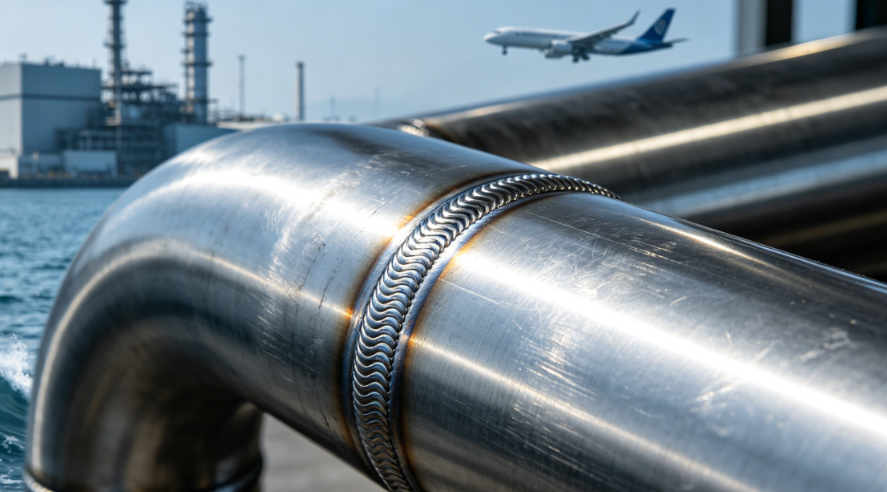
When industrial applications demand uncompromising performance—corrosion resistance, high strength, and light weight—titanium welded tubes stand out as the ultimate solution. They outperform traditional materials like stainless steel and aluminum in harsh environments, making them indispensable for aerospace, marine, petrochemical, and medical industries.
This technical guide explores the benefits, specifications, and key applications of titanium welded tubes.
1. Core Advantages of Titanium Welded Tubes
Superior corrosion resistance: Titanium’s natural oxide layer protects against saltwater, acids, and chemicals, outlasting stainless steel in corrosive environments.
High strength-to-weight ratio: Strong yet lightweight, titanium welded tubes reduce overall system weight without sacrificing durability, a critical benefit for aerospace and marine applications.
Temperature stability: They maintain structural integrity at both high and cryogenic temperatures, making them suitable for extreme conditions.
Biocompatibility: Medical-grade titanium tubes are safe for use in implantable devices and surgical equipment.
2. Key Specifications & Standards
Titanium welded tubes are typically manufactured to strict industry standards, including:
ASTM B338: Standard specification for welded titanium tubes for heat exchanger and condenser service.
ASTM B861: Standard specification for welded titanium tubes for general corrosion-resistant and high-temperature service.
Common grades: Grade 1/2 (pure titanium) for corrosion resistance, Grade 5 (Ti-6Al-4V) for high-strength applications.
3. Industrial Applications
Marine engineering: Desalination plants, offshore pipelines, and shipboard systems rely on titanium tubes to resist saltwater corrosion.
Aerospace: Lightweight titanium tubes are used in aircraft hydraulic systems, fuel lines, and environmental control systems.
Petrochemical: Heat exchangers, reactors, and pipelines in chemical processing plants use titanium to handle corrosive fluids.
Medical: Titanium tubes are used in surgical instruments, implantable devices, and diagnostic equipment.
4. Buyer Considerations
When sourcing titanium welded tubes, ensure:
Compliance with relevant ASTM standards and material certifications.
Proper weld quality and non-destructive testing (NDT) to ensure joint integrity.
Surface finish and passivation to maximize corrosion resistance.
Matching the titanium grade to your specific application’s environmental and mechanical requirements.
Conclusion
Titanium welded tubes offer a unique combination of properties that make them irreplaceable in high-performance industrial applications. Their ability to withstand corrosion, high temperatures, and stress, while remaining lightweight, ensures long-term reliability and reduced maintenance costs. For industries pushing the limits of material performance, titanium welded tubes are the ultimate choice.
Technical Guide5 min read·2026-06-12
Titanium Welded Tube: The Ultimate Choice for High-End Industrial Applications
In industries requiring extreme material performance, titanium welded tubes outperform stainless steel and aluminum. Discover their core advantages, key specifications, and applications in aerospace, marine, medical, and petrochemical fields.