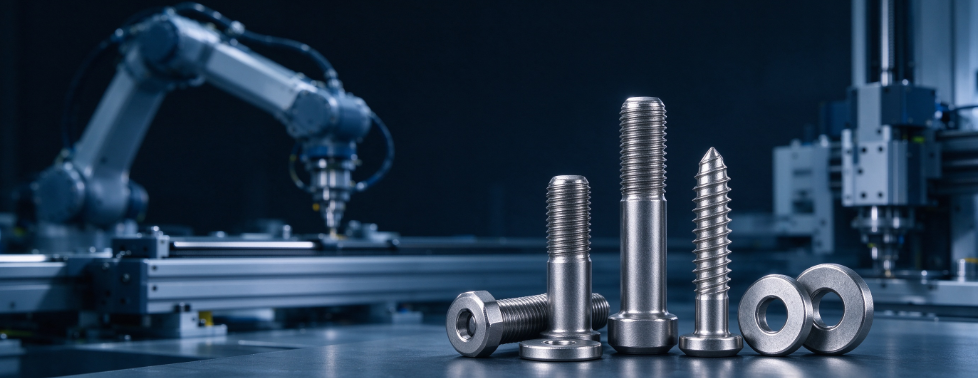
Titanium fasteners play a vital role in high-end automation equipment, particularly in precision machinery, intelligent production lines, robotic systems, semiconductor manufacturing equipment, medical devices, aerospace automation and advanced industrial testing instruments.
Unlike ordinary steel or stainless steel fasteners, titanium and titanium alloy fasteners offer a unique combination of low density, high strength, excellent corrosion resistance, good fatigue performance and thermal stability. These properties make them suitable for automated systems that operate under demanding conditions such as frequent vibration, precise positioning, clean manufacturing environments and corrosive media exposure.
1. Precision Automation Machinery and Intelligent Production Lines
In high-speed automation equipment, lightweight design helps reduce inertial load and improve dynamic response. Titanium fasteners are used in key assemblies such as linear modules, precision slides, robot end effectors, tool changers and high-speed moving components.
Their high specific strength enables weight reduction without sacrificing clamping force or structural rigidity. This is especially valuable in machines that require fast acceleration, deceleration and repeated positioning accuracy.
2. Industrial Robotics and Collaborative Robots
Industrial robots, cobots and automated handling systems benefit from titanium fasteners in several ways. They are commonly used in robot arms, end-of-arm tooling, grippers, sensors mounts and precision joint assemblies.
The main benefits include:
Weight reduction of moving parts
Lower inertia for faster motion control
Improved structural stability
Good fatigue resistance under cyclic loading
Reduced risk of loosening in dynamic operation
For high-precision robots, the consistent dimensional stability of titanium fasteners also supports long-term positioning accuracy.
3. Semiconductor and Electronics Manufacturing Equipment
High-end automation equipment in the semiconductor and electronics industry requires clean, reliable and non-contaminating materials. Titanium fasteners are used in wafer processing equipment, semiconductor test handlers, SMT assembly machines, precision inspection systems and vacuum process modules.
Titanium offers:
Excellent corrosion resistance against process chemicals and cleanroom environments
Low outgassing performance in vacuum and high-purity applications
No magnetic interference for sensitive measurement systems
High purity and surface quality
Reduced risk of rust and particle generation
These properties help improve equipment uptime and maintain stable production quality.
4. Medical Automation and Medical Device Equipment
Titanium fasteners are widely adopted in medical automation equipment due to their biocompatibility, cleanliness and corrosion resistance. Typical applications include surgical robot systems, medical imaging devices, automated diagnostic equipment, drug delivery systems and precision laboratory instruments.
Medical-grade titanium fasteners can meet strict hygiene and reliability requirements, including compatibility with sterilization processes and clean manufacturing environments.
5. Aerospace and Defense Automation Systems
In aerospace automation, titanium fasteners are used in aircraft component assembly lines, satellite testing equipment, missile guidance systems, radar equipment and other high-value automated systems.
They are preferred for:
High strength-to-weight ratio
Excellent fatigue resistance
Good thermal stability
Corrosion resistance in harsh service environments
Long-term structural reliability
Aerospace-grade titanium fasteners often require strict material traceability, precise dimensional control and full inspection documentation.
6. Automotive Intelligent Manufacturing and New Energy Equipment
High-end automation is also widely used in automotive intelligent manufacturing, new energy battery production, electric motor assembly and intelligent vehicle testing lines. Titanium fasteners are suitable for lightweight fixtures, high-speed conveyors, precision pressing equipment and battery module assembly systems.
By reducing the weight of movable tooling and fixtures, titanium fasteners help improve cycle time and reduce energy consumption while maintaining structural rigidity.
Common Titanium Grades for Fasteners
Different automation equipment scenarios require different titanium grades. The most common options include:
Grade 2 (CP Titanium): Good corrosion resistance, excellent formability and moderate strength. Suitable for general industrial automation and mild corrosive environments.
Grade 5 (Ti-6Al-4V): High strength, high specific strength and good fatigue resistance. The most widely used titanium alloy for high-performance fasteners.
Grade 23 (Ti-6Al-4V ELI): Higher toughness, better ductility and improved biocompatibility. Often used in medical devices and high-precision applications.
Grade 12: Excellent corrosion resistance in chloride and acidic environments. Suitable for chemical-related automation equipment.
Key Advantages of Titanium Fasteners in Automation Equipment
High specific strength: Strong and lightweight, ideal for dynamic automation components.
Corrosion resistance: Performs well in chemical, medical, cleanroom and humid environments.
Fatigue resistance: Suitable for long-term cyclic loading and frequent motion.
Thermal stability: Maintains stable mechanical properties under temperature changes.
Non-magnetic: Safe for precision sensors and electronic measurement equipment.
Biocompatibility: Essential for medical automation and medical device applications.
Long service life: Reduces maintenance and replacement frequency.
Design and Selection Considerations
When selecting titanium fasteners for high-end automation equipment, engineers should consider the following factors:
Required tensile strength and clamping force
Operating temperature range
Corrosive media and environmental conditions
Fatigue and vibration requirements
Magnetic sensitivity of nearby components
Biocompatibility requirements for medical applications
Dimensional accuracy and tolerance requirements
Material traceability and certification needs
It is also important to consider the screw length, thread engagement, installation torque and surface treatment to avoid galling or thread damage during assembly.
Summary
Titanium fasteners are a high-performance solution for high-end automation equipment, especially in applications that demand lightweight design, precision positioning, corrosion resistance, fatigue durability and long-term reliability.
They are widely used in industrial robots, semiconductor equipment, medical devices, aerospace automation, intelligent production lines and new energy manufacturing systems. By choosing the right titanium grade and fastening system, manufacturers can improve equipment performance, extend service life and reduce total cost of ownership.
If you need custom titanium fasteners for automation equipment with material certificates and precision dimensional control, please contact us for technical support and quotation.
Technical Guide5 min read·2026-11-04
Titanium Fasteners in High-End Automation Equipment
Titanium fasteners are widely used in high-end automation equipment where weight reduction, corrosion resistance, high specific strength, thermal stability and long-term reliability are critical. This guide covers their applications, advantages, common titanium grades and selection considerations for precision automation systems.