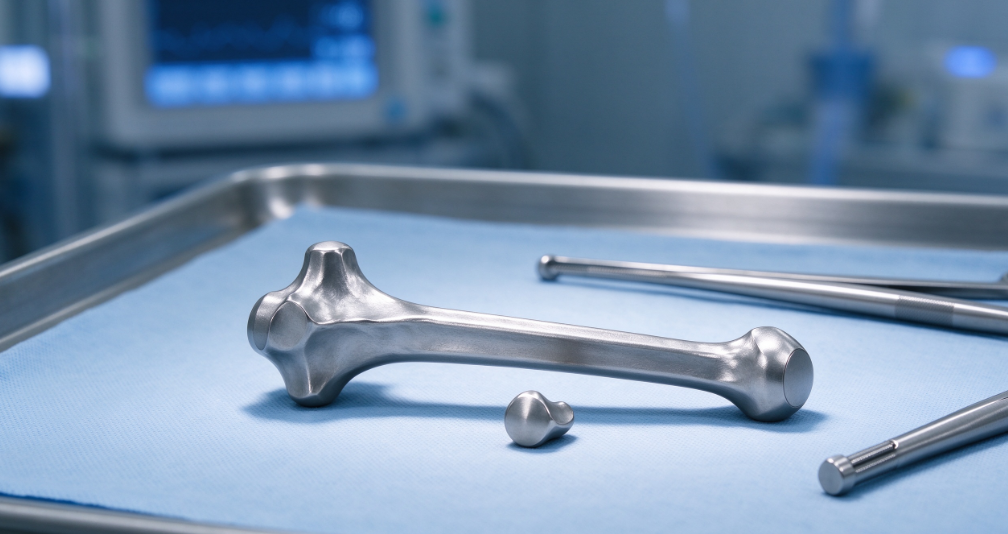
Medical devices and implants demand strict material performance: non-toxicity, biocompatibility, corrosion resistance, suitable mechanical strength and fatigue resistance inside the human body. Stainless steel, cobalt-chrome alloys and other materials have limitations such as ion precipitation, magnetic interference and high modulus mismatch. Medical titanium has become the gold standard for implantable and surgical medical components.
Core Advantages of Medical Grade Titanium
1. Excellent Biocompatibility
Titanium forms a stable, inert TiO₂ passive film immediately when exposed to body fluid. This oxide layer is non-toxic, does not trigger rejection or inflammatory reactions, and supports osseointegration — bone tissue can grow directly onto the titanium surface. This unique property makes titanium the top choice for permanent implants.
2. Outstanding Corrosion Resistance in Body Fluid
Human body fluid is a warm chloride-containing saline environment. The passive film of titanium resists corrosion by blood, interstitial fluid and body electrolytes, avoiding metal ion release and long-term tissue irritation.
3. Low Elastic Modulus Close to Human Bone
Compared with steel and cobalt alloys, titanium’s elastic modulus is much closer to cortical bone. It greatly reduces the “stress shielding” effect, preventing bone atrophy around the implant after long-term implantation.
4. Non-Magnetic & MRI Safe
Medical pure titanium and Ti‑6Al‑4V ELI are non-magnetic. Patients with titanium implants can safely undergo MRI scans without implant displacement, heating or image distortion.
5. Good Machinability, Weldability and Surface Treatment
Medical titanium can be precision CNC machined, polished, anodized, sandblasted and acid-etched to create rough surfaces for better bone bonding. It is suitable for mass production of tiny and complex medical parts.
Common Medical Titanium Grades & Standards
Grade 2 (CP Titanium, ASTM F67)
Commercially pure titanium, high ductility, excellent biocompatibility. Widely used for dental implants, bone plates, fixation screws, stents and non-load-bearing soft tissue implants.
Grade 5 ELI (Ti‑6Al‑4V ELI, ASTM F136)
Extra low interstitial variant of TC4 titanium alloy. Higher strength and fatigue resistance. The main grade for heavy-load orthopedic implants: hip stems, knee components, spinal fixation systems.
Grade 23 (Ti‑6Al‑4V ELI, higher purity variant)
Premium medical alloy for high-demand implant devices, strict impurity control for long-term implantation.
Typical Application Areas
✅ Orthopedic Implants
Bone plates, locking screws, intramedullary nails, hip prostheses, knee prostheses, spinal pedicle screws, interbody fusion cages.
✅ Dental Devices
Dental implants, abutments, surgical transfer posts, denture frameworks, orthodontic anchors.
✅ Surgical Instruments
Titanium forceps, scissors, retractors, surgical handles. Lightweight and corrosion-resistant, easy to sterilize by autoclave repeatedly.
✅ Cardiovascular Devices
Nitinol and titanium stents, closure devices, pacing lead components.
✅ Other Medical Equipment
Medical equipment housings, surgical robot structural parts, medical fixture bases, radiation shielding accessories.
Critical Quality & Procurement Notes
Medical grade is strictly separated from industrial titanium:Medical titanium requires controlled interstitial elements (O, N, C, Fe), certified by ASTM F67 / F136, with complete material MTR. Industrial TA1/TA2 cannot be used for implants.
Surface finishing control:Implant-grade parts require ultra-clean surface, acid etching or sandblasting for osseointegration; residual contamination is not allowed.
Sterilization compatibility:Titanium withstands repeated autoclave, EO gas and plasma sterilization without performance degradation.
Traceability:Medical projects require full heat number traceability and EN 10204 3.2 certificates for implant-grade material lots.
Summary
Thanks to superior biocompatibility, osseointegration capability, chloride corrosion resistance and MRI compatibility, medical titanium is irreplaceable in modern implantology and surgical equipment. Proper grade selection and strict medical material certification are essential for medical device manufacturers.
Contact us for medical grade titanium bar, sheet and custom precision parts, with full ASTM certification support.
Technical Guide5 min read·2026-10-22
Titanium Applications in Medical Devices
Explore medical grade titanium and titanium alloys for medical devices. Learn biocompatibility, common grades ASTM F67 Gr2, ASTM F136 Gr5 ELI, typical applications in orthopedics, dental, surgical instruments and procurement specifications.